PROJECT RESULT 1: A Guide for Young Innovator
1. Creating Eco-Friendly Products:
This guide is part of the Erasmus+ funded.
The Eco-maker project provides students aged 10-14 with essential insights into creating sustainable products.
It is an educational resource that explains how eco-friendly products can be designed and manufactured.
Students can either go through the logbook first to learn about eco-friendly product creation or start with the design challenge and refer to the logbook for necessary information as needed.
2. Content of the Guide for Young Innovators to Drive Sustainability
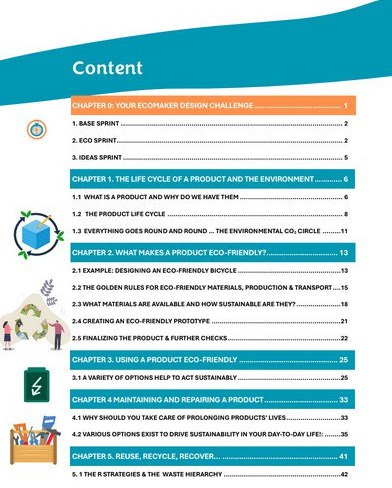
0. YOUR ECOMAKER DESIGN CHALLENGE
1. THE LIFE CYCLE OF A PRODUCT AND THE ENVIRONMENT
2. WHAT MAKES A PRODUCT ECO-FRIENDLY?
3. USING A PRODUCT ECO-FRIENDLY
4. MAINTAINING AND REPAIRING A PRODUCT
5. REUSE, RECYCLE, RECOVER
3. The EcoMaker Design Sprint: 3 Phases to CreateEco-Friendly Product
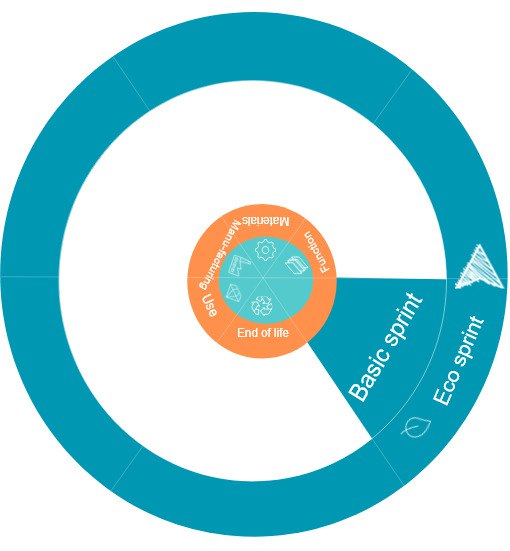
Through the EcoMaker Design Sprint, students unlock the eco-friendly potential of their products. The sprint is divided into three phases: the “Base Sprint,” “Eco Sprint,” and “Ideas Sprint.” Throughout each phase, students work with the EcoMaker Circle- a poster for labeling and organising their ideas.
The individual work steps are arranged on the canvas as concentric rings. You work your way from the inside out during the sprint. Each of these rings is also divided into segments that help you see the product in all its life phases.
4. The Life Cycle of a Product and Environmental Impacts
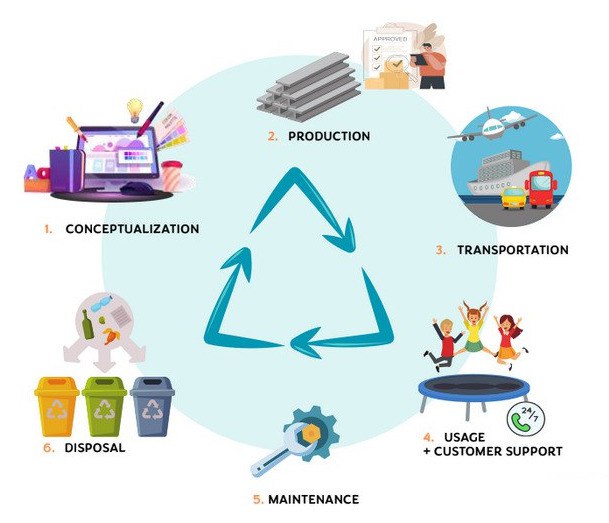
This section provides information about the life cycle of products. It explains how design, production, use, and recycling phases impact the environment and offers ways to minimize these effects. When we say that a product has a life cycle, we mean that it goes through a series of stages from its creation to its
eventual decline and discontinuation. Just like living beings, products have a beginning, a period of growth and maturity, and an en end.
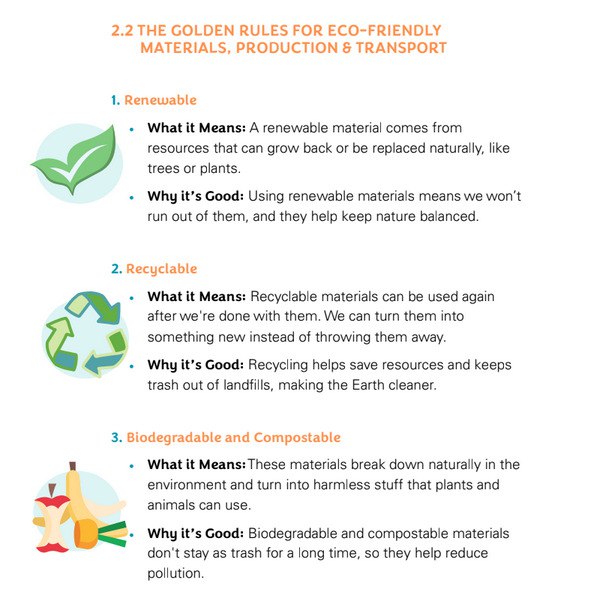
5. The Golden Rules for Designing Eco-Friendly Product
Learn how to ensure sustainability in material
selection, production, and transport processes. This section covers tips for choosing renewable, recyclable, and biodegradable materials, along with eco-friendly production methods.
6. A Variety of Options Help to Act Sustainably
Tips on how to reduce the environmental impact of products during their use by opting for eco-mode settings and energy-efficient features:
- Eco-Mode Settings (enable energy efficiency fast and easy)
- User Education and Information (Guide to a Sustainable Future)
- Feedback Systems (live data for green awareness)
- Incentivizing Sustainable Practices
- Behavioral Nudges
- Product Design Features
- Supporting Sustainable Behavior
- Promotion of Sustainable Practices
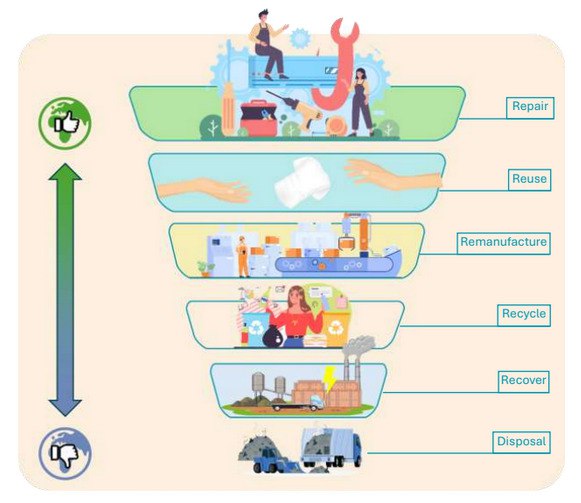
7. The “R” Strategies: Repair, Reuse, Recycle
Strategies for extending product life through repair, reuse, and recycling are introduced. These strategies guide students in developing environmentally
responsible solutions.
The “R” strategies help us make less trash, which means fewer big piles of garbage, less pollution, and a cleaner world for everyone. You don’t produce
everything from scratch and use the “R” strategies we help to keep our air, water, and soil clean and healthy for people, animals, and plants.